Sven Grünberg(born 24 November 1956, Estonia) is an Estonian ambient and progressive rock composer and musician most known for his meditative organ and electronic works involving the concepts of Tibetan Buddhism. He has collaborated with the film director Olav Neuland and written the soundtracks for the most of his films.
In the 1970s Grünberg was the leader of the progressive rock band Mess, which was founded by him in January 1974 together with Härmo Härm. Despite the years of the band's existence and many live performances, Mess did not release a single studio album because of the contradictions of their musical style with the Soviet ideology; only in 1996 did Grünberg released a compilation from several survived Mess recordings and a full remastered album in 2004.
01 - Main Street 02 - Saxmaniax 03 - The Fire In His Guitar 04 - French Perfume 05 - Take My Hand 06 - Don't You Feel Better 07 - Indiana Rainbow 08 - I Should Have Known
Recorded in 1976 A.D. .... Well, that more or less sums it up really. The powers that be (at the time) decided in their infinite widom, that this album should not be released. (THEY KNOW WHO THEY ARE). In my opinion, this was nothing short of a crime. Now hopefully, the album is in the hands of a company who genuinely cares about music.
Until just recently, I had not even heard the album for around ten years, and had probably written it off. To be honest, I was not even sure whether I would still like it, but I must say that I was pleasantly surprised. My first reaction was that it needed a remix, but the original multi track tapes were not available anyway, so that was out of the question. Basically, if you can adjust your ears to the fact that this album was produced with the aid of studio equipment that is more than twenty years old, then it sounds okay. At the time of recording this album, Wizzard as a working band had really ceased to exist.
This was probably a last attempt to retain some sort of sanity, trying to grow up, and not carry on indefinitely being just another pop group. We had experimented previously with this style, on B sides of singles, but never really had the opportunity to express ourselves fully in the kind of music that we genuinely preferred to play. I would like to believe that, if this album had been released when it was first created, then my writing style would have taken a different curve, and we would have been performing the type of material that bands such as Jamiroquai are being successful with right now.
In my opinion, I would say that the years have not jarred the quality of the songs, or even the performance and arrangements, because this album cannot be restricted to a definite era or time span.
That is only my opinion... What do you think?? - Roy Wood, Main Street 2000 liner notes
Main Street, credited to Roy Wood & Wizzard (whereas the group's first two albums had been credited simply to Wizzard), was initially planned to showcase the more jazz-rock, deliberately uncommercial, side of the group as part of a double album, along with the material that became the album Introducing Eddy & The Falcons in 1974. When they eventually recorded Main Street (or Wizzo as it was originally to be called) in 1975-6, the group had rather slipped out of the public eye and was on the point of disbanding. The single, also credited to Roy Wood’s Wizzard, "Indiana Rainbow" (backed by a non-album track "The Thing Is This (This Is The Thing)"), released in March 1976, stiffed completely, and did not even make the BBC Radio 1 playlist. As a result Jet Records, to whom Wood was signed at the time, cancelled the album's release. The tapes only came to light in 1999 and, with Wood's blessing, released by Edsel, a re-issue label which specialised largely in licensing long-deleted albums from major companies and had recently made Introducing Eddy & the Falcons, available on CD for the first time. - Wikipedia
Recorded Columbia Studio E, New York City June 19 or 20, 1974
Miles Davis ► electric trumpet w/ wah wah
Dave Liebman ► alto flute
Pete Cosey ► electric guitar
Reggie Lucas ► electric guitar
Dominique Gaumont ► electric guitar
Michael Henderson ► bass guitar
Al Foster ► drums
James Mtume ► percussion
B1
Maiysha
Recorded Columbia Studio E, New York City October 7, 1974
Miles Davis ► electric trumpet w/ wah wah, organ
Sonny Fortune ► flute
Pete Cosey ► electric guitar
Reggie Lucas ► electric guitar
Dominique Gaumont ► electric guitar
Michael Henderson ► bass guitar
Al Foster ► drums
James Mtume ► percussion
B2
Honky Tonk
Recorded Columbia Studio E, New York City May 19, 1970
Miles Davis ► trumpet
Steve Grossman ► soprano saxophone
John McLaughlin ► electric guitar
Keith Jarrett ► electric piano
Herbie Hancock ► clavinet
Michael Henderson ► bass guitar
Billy Cobham ► drums
Airto Moreira ► percussion
B3
Rated X
Recorded Columbia Studio E, New York City September 6, 1972
Miles Davis ► organ
Cedric Lawson ► electric piano
Reggie Lucas ► electric guitar
Khalil Balakrishna ► electric sitar
Michael Henderson ► bass guitar
Al Foster ► drums
James Mtume ► percussion
Badal Roy ► tabla
C1
Calypso Frelimo
Recorded Columbia Studio E, New York City September 17, 1973
Miles Davis ► electric trumpet w/ wah wah, electric piano, organ
Dave Liebman ► flute
John Stubblefield ► soprano saxophone
Pete Cosey ► electric guitar
Reggie Lucas ► electric guitar
Michael Henderson ► bass guitar
Al Foster ► drums
James Mtume ► percussion
D1
Red China Blues
Recorded Columbia Studio E, New York City March 9, 1972
Miles Davis ► Electric trumpet w/ wah wah
Wally Chambers ► harmonica
Cornell Dupree ► electric guitar
Michael Henderson ► bass guitar
Al Foster ► drums
Bernard Purdie ► drums
James Mtume ► percussion
Wade Marcus ► brass arrangement
Billy Jackson ► rhythm arrangement
D2
Mtume
Recorded Columbia Studio E, New York City October 7, 1974
Miles Davis ► electric trumpet w/ wah wah, organ
Pete Cosey ► electric guitar
Reggie Lucas ► electric guitar
Michael Henderson ► bass guitar
Al Foster ► drums
James Mtume ► percussion
Sonny Fortune ► flute
D3
Billy Preston
Recorded Columbia Studio E, New York City December 8, 1972
Miles Davis ► electric trumpet w/ wah wah
Carlos Garnett ► soprano saxophone
Cedric Lawson ► Fender Rhodes electric piano
Reggie Lucas ► electric guitar
Khalil Balakrishna ► electric sitar
Michael Henderson ► bass guitar
Al Foster ► drums
James Mtume ► percussion
Badal Roy ► tabla
Get Up With It is an album collecting tracks recorded between 1970 and 1974 by Miles Davis. Released on November 22, 1974 as a double LP, it was Davis' last studio album before five years of retirement from music.
"He Loved Him Madly" is a track recorded in tribute to Duke Ellington, who had died one month before; Brian Eno cited it as a lasting influence on his own work. - Wikipedia
We had [a] machine invented when we were doing a record called Get Up With It by Miles. We were dedicating a number to Duke Ellington ("He Loved Him Madly"). And I put this track through this piece of equipment. I called Miles up and I says, "Look, something unusual happened here. I can't figure it out. I don't know what it is, but I hear the Duke Ellington band. Not your band, the Duke Ellington band, coming through the speakers." Holy Christ, mean it was traumatic and exciting at the same time. I couldn't believe what I was hearing.
The instruments, whatever they were, it sounded like the rhythm section. I mean the soloists and the brass and saxophones came right straight through. The next day we tried to duplicate it, but couldn't do it. We didn't touch the machines. It's like somebody had pushed a button, and out came Duke. Because, it was a tribute to Duke Ellington. I mean that sounds kind of scary to me but that's what happened. I've used it since and it hasn't created the same kind of illusion. But I think Duke was there in that room that day. - Teo Macero, "Interview by Iara Lee," Perfect Sound Forever (September 1997)
1973 saw more touring, and the occasional bit of studio recording by Miles’ band. In 1974 a unit of Davis, Henderson, Foster, Mtume, Lucas, and Gaumont, plus new feedback-freakout-oriented guitarist Pete Cosey, with Dave Liebman and/or Sonny Fortune on sax and flute, cut the majority of tracks to be released on Get Up With It. (Some sessions from preceding years were used as well). This record could be seen as the culmination of Miles’ career; it’s some serious business. The key to the album is Henderson’s bass - his playing is perfect and huge. Foster’s drumming provides the perfect foil to him, and you’ve got a thoroughly grounded musical maze starting already. Then add Mtume’s shifting, inventive percussion to that, and stack two rhythmic guitar players on along with one feedback-oriented player (who does some nice soloing on this album) - now you’ve got some great shifting funk going on. Then put Miles on in a surly mood, playing some serious, no-frills trumpet and raising some hell on organ too. It’s quite a trip. I shouldn’t forget Dave Liebman’s contributions - there are some who say that he was partially responsible for "Mayishia", a thoroughly perfect musical act in two parts on here. And Sonny Fortune plays well, and some other names pop up on the recordings as well. Side 1 of this record is a bit strange, a tone-poem dedicated to Duke Ellington who had recently passed away. Side 2 contains "Mayishia" and the strong, deeply funky "Honky Tonk" (actually recorded years previously with a whole host of famous musicians), as well as the bizarre "Rated X". Side 3 is an out-of-control madhouse piece called "Calypso Frelimo" which shows this band at their most anarchic, but clears way for another killer bassline after a while. Side 4 features the dense, energetic "Mtume" (an amazing cut which typifies this band’s sound) and the funky "Billy Preston", along with a relatively traditional piece, "Red China Blues". Each side is about 30 minutes long. If I had to describe this record with one word, the word I would choose would be "massive". This is one that you’ll be taking the measure of for years and years. - Scott McFarland, "Miles Davis : The 'Electric' Years", Perfect Sound Forever (August 1997)
What qualified a piece for inclusion on [Ambient 4: On Land] was that it took me somewhere, but this might be somewhere that I'd never been before, or somewhere I'd only imagined going to. […] We feel affinities not only with the past, but also with the futures that didn't materialize, and with the other variations of the present that we suspect run parallel to the one we have agreed to live in.
The choice of sonic elements in these places arose less from listening to music than from listening to the world in a musical way. When I was in Ghana, for instance, I took with me a stereo microphone and a cassette recorder, ostensibly to record indigenous music and speech patterns. What I sometimes found myself doing instead was sitting out on the patio in the evenings with the microphone placed to pick up the widest possible catchment of ambient sounds from all directions, and listening to the result on my headphones. The effect of this simple technological system was to cluster all the disparate sounds into one aural frame; they became music.
Listening this way, I realised I had been moving towards a music that had this feeling; as the listener, I wanted to be situated inside a large field of loosely-knit sound, rather than placed before a tightly organised monolith (or stereolith, for that matter). I wanted to open out the aural field, to put much of the sound a considerable distance from the listener (even locating some of it "out of earshot"), and to allow the sounds to live their lives separately from one another, clustering occasionally but not "musically" bound together. This gave rise to an interesting technical difficulty. Because recording studio technology and practice developed in relation to performed music, the trend of that development has been towards greater proximity, tighter and more coherent meshing of sounds with one another. Shortly after I returned from Ghana, Robert Quine gave me a copy of Miles Davis' "He Loved Him Madly". Teo Macero's revolutionary production on that piece seemed to me to have the "spacious" quality I was after, and like [Federico Fellini's] "Amarcord", it too became a touchstone to which I returned frequently. - Brian Eno, Ambient 4: On Land 1986 liner notes
01 - So Far Backie 02 - Follow Me To The Store 03 - Yellow Frog Legs 04 - Donavon Palsy Master Ward 05 - Our House Is Important 06 - Bitchen Transmission 07 - Spaceman And Human 08 - 48 Of Stars 09 - Stutterer 10 - Ducks Abduct 11 - Only Kids Of Nothing Star 12 - Pizza Hut Families Rule 13 - From Death Trap 14 - Ten Foot Barbie Ward 15 - I Said Momma 16 - Teen Texas Concert 17 - Oh My Goodness 18 - Electric Valley 19 - Mommy On Drugs 20 - Broadway World Kids 21 - We Come From A Land 22 - Starcle Manee Alien 23 - Baby FSM 24 - Starcle Cartoon Glossolalia 25 - Crevice Block Poet 26 - Gomblasemba Lumbieca 27 - Calm Stay Calm 28 - You Will Realize Me
This FSM history album (spanning 1992-1998) for study by government demons and cartoons for Japanese kid of audience is not gay. But this is a gay press release for the University Press and Disney CGI.
Meanwhile, Only Kids of Nothing Star by the two guys in Five Starcle Men has been released on the Net, with the band's Web history claiming that one of the two killed himself a while ago. Eighty percent of it is cack—cheap software chitter and silicon noises—but the duo's mythology indicates they were dextromethorphan punks, feeling the need to dull existential pain.
Two Nothing Star numbers are rhythmically compelling. One rips off Beck's "Loser" riff; another has a harmonica sound and the chant "Pizza Hut families transcend spiritual reality." However, because Five Starcle Men were downers, honestly horrid, and maybe nuts, they never made a video featuring the glum faces of dysfunctional boozer parents, stealthily corrosive friends, and assorted earnest-looking made-for-TV ringers. - George Smith, "Go Ahead, Kill Yourself," in The Village Voice (January 20, 2004)
These kids were involved in alien drug torture and deadly cartoon culture governments. They loved performing their little hit "Pizza Hut Families Rule" which often led to their being kicked off stage by the police or various forces that didn't like the song. Using modern cultural, pharmacological, and other technologies, these young suburban punks constructed highly aestheticized, delusional realities for themselves and their viewers, often resulting in a dangerous sense of political and intellectual ability. Glen Hobbs soon died by suicide. He left many fabulous artifacts. Luke McGowan now studies science, philosophy, and history at university.
They built and played on home made insturments and bent looped electronics from toy stores and Radio Shack.
The label "Lost Frog" from Japan sells their CD and a documentary about the deadly chain of events that resulted from the Five Starcle Men chain of Dextromethorphin abuse is in the making. They came from Lancaster, Ca. (1991-1998) - Rich, tribe.net
gonna listen to this later for sure my friend rich polysorbate 60 was really into starcle men mythology apparently you see them on large doses of dxm … yea, i dont know his real last name, he had it legally changed to that member of the long gone LA chaos society (its not chaos, a word like chaos i can't recall right now), lives in long beach and is really into making fake mythology real, like planting fake dead bodies, and giving lectures on skunk apes at universities and such. He would mention starcle men a lot, and him and his buddies had stickers and drawings of them and one even had a tattoo of one. But I don't remember much other than they are common DXM dis-associative hallucinations. As these guys are from LA, it's probably part of the same circle of DXM lovers. Not really sure. … ok, so chris (baboon torture division) said this about it: "It could be a fictitious band invented by Rich for all I know. Jeff McLean has a starcleman tattoo. According to Rich, the music was all made during DXM trips and was somehow influenced by 5 dimensional aliens. I don't think it's too much of a stretch if you believe in telepathic communication, that aliens would have an easier time contacting us psychically than using radio waves. Maybe people in a dissociative state such as a DXM or DMT trip are more receptive to these kinds of things." … [www.erowid.org] a reference to the dxm-alien connection - Dr. Rek, braindance! forum
Five Starcle Men - Gomba Reject Ward Japan : ZIP / stream
Made under a variety of pressures, Gaucho was the final album by Steely Dan for almost twenty years. This long unauthorized release reveals an albums side worth of hits that would intrigue well past die hard-Danners. Inclusive in this recording is several skeletal demos of released songs (Time Out of Mind, an instrumental of the title track (Gaucho), and an early demo of "Third World Man" entitled "Were You Blind That Day," the titularly themed refrain), as well as several unreleased gems.
"Kulee Baba," (a version with Donald Fagan playing piano and singing and one with a small band) is the standout of the record with smooth, extended jazz chords. The song narrates images of an ambitious television executive shooting the allusive "Kulee Baba,":
"Brightly colored dancers on-screen Are no more than a prelude to the ritual unfolding No white man's eyes have ever seen The cruel primeval rite that you're beholding!"
Not secondary is the "Second Arrangement" famous for not appearing on Gaucho due to being accidentally half erased by an engineer. Reminiscent of a more tender"Royal Scam"-esque cuckold-romantic endeavors it contains a sweetly bridged-bass line and lyrics not far removed in essence from "Time Out of Mind".
Finally, "The Bear;" a seemingly finished track is a stellar performance all around. "There's a bear that walks like a man, you better shake him fast."
B1 - Abschied B2 - Segnung B3 - Andacht B4 - Nicht Hoch Im Himmel B5 - Andacht
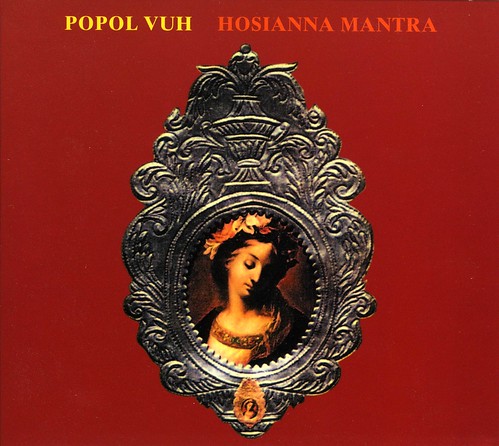
In 1972 Florian Fricke converted to both Christianity and Hinduism, and decided to move even further away from electronic instruments, preferring the most humble acoustic instruments over high-tech devices. A new line-up, centered around the angelic wails of Korean soprano Djong Yun, recorded Hosianna Mantra (Pilz, january 1973) in a Buddhist meditative tone, showing a solemn and elegant way to bridge the Western mass and Eastern meditation. Fricke on keyboards, Amon Düül II's guitarist Conny Veit, Between's Robert Eliscu on oboe, Fritz Sonnleitner on violino, Klaus Wiese on tambouras build up ascetic atmospheres that catapult the listener into Tibetan or Gregorian monasteries. Most of the interplay is between the piano (tenderly caressed by Fricke) and the guitar (whose phrasing simulates the Indian mantras). The other instruments add evocative power to the music, rarely altering the flow, in a manner similar to renaissance music. The key difference between this music and classical or rock music is the repudiation of rhythm: Tangerine Dream was removing rhythm (i.e., Time) from its cosmic soundpainting, and Popol Vuh removed rhythm (i.e., Time) from its spiritual soundpainting. - Piero Scaruffi
Is this the same group? I can only imagine what hungry young Germans heads must have been thinking when back in 1972, eager for more wild outer space music, they opened up the plastic, slipped the LP out of its sleeves and put Hosianna Mantra on the turntable.
Gone were Holger Trülzsch and Frank Fiedler, gone was the Moog synthesizer, and in were Conny Veit (electric and 12-string guitar), Robert Eliscu (oboe), Klaus Wiese (tamboura), Fritz Sonnleitner (violin) and Djong Yun (vocals). One might expect some changes with a whole new line-up (besides the ever-present Fricke, now on piano), even significant ones, but this was nothing short of revolutionary.
Hosianna Mantra has virtually NOTHING WHATSOEVER to do with the two albums that preceded it. Part of that was due to Djong Yun. Fricke said, "I always had this great desire to find an instrument that could express a human voice, of vocals or the singing of a girl for instance, by electronic means. When you listen to In Den Gärten Pharoas on the A-side you will find this voice. And all of a sudden this voice that I felt was in myself really came into my life when Djong Yun appeared. Fricke also said, "I'm a conservative artist, not interested in just pressing buttons, so I went back to piano. Sometimes the power would vary so you couldn't always get the same sound on the synthesizer. It's too dependent on the machinery. It's nothing human. The piano is more direct. That's when I realized that I'd probably be happier if I lived my life with music that had acoustic instruments.
He also said, "Hosianna Mantra is actually a combination of two different cultures, two different languages, two different lives. It has a dual meaning; ‘Hosianna,' which is a religious Christian word and ‘Mantra,' from Hinduism. Behind all of that I was convinced that basically all religions are the same. You always find it in your own heart. Fricke referred to Hosianna Mantra as "a mass, a church mass, but not for church - a conscious reflection upon religions origin is included in this music, but not in particular to any religious groups. I don't want to use synthesizers as part of Christian religious music, but you can't refer to it as church music unless you consider your own body as a church and your ears as its door.
So how does it sound, you ask? Nothing short of majestic - a revelation, an epiphany, a high point in the history of music. From the first moments of the first track (the appropriately named "Ah!"), we know that this is something special. Suddenly Florian Fricke puts to use all those years of musical training on the piano to create something wonderful. The instrumentation outside of the piano keeps the song flowing along, but the piano drives this song with chords and runs up and down the length of the piano that must have sounded radical even to avant-garde jazz fans, and yet the whole thing is beautiful and peaceful.
Once we get to the second track, "Kyrie," electric guitar takes over as the dominant instrument, and never before have I heard such beautiful, fluid, melodic sounds emanate from an electric guitar. Conny Veit came over to Fricke's house every day for almost half a year to prepare for this album. Entering next are the soaring soprano vocals of the Korean Djong Yun, and we're transported to a musical landscape heretofore unseen. The lyrics are based on a text by Martin Buber, a Jewish philosopher, but unless you're fluent in Latin you won't understand what's being said anyway. With singing this beautiful, Yun could be singing the proverbial phone book and it wouldn't matter. She truly becomes another instrument.
The song dips, swoons, soars and takes off, and we haven't even gotten to the ten-minute "Hosianna Mantra," truly one of the most beautiful and unique pieces of music ever to grace the earth. Where Fricke was channeling this stuff from is a mystery, but we're well out of the realm of krautrock and electronic music here and into something that can perhaps only loosely be described as rock. I will say no more about the song "Hosianna Mantra" other then around the 5:15 mark, soon after the oboe enters the mix, Djong Yun does something vocally that is one of the most spinetingling moments I've ever heard in music. Side one is truly musical perfection on another plane.
Though side one contains three separate tracks, the side itself is called "Hosianna Mantra." Side two is called "Das V. Buch Mose" ("The Fifth Book of Moses") and is more pastoral, more classical, and it's here where perhaps the roots of what prompted people to later refer to Popol Vuh as new age music sprouted from. It still carries the same instrumentation as side one; the same beautiful vocals, the same fluid guitar, the same pulsating tamboura, oboe and violin, but it's more muted and gentle. I don't find myself listening to side two nearly as much as side one, but it would be hard to deny its beauty. - Gary Bearman
You don't have to spend any money advertising an album if it has lenticular cover art
Following the collapse of Skinny Puppy, cEvin Key and Dwayne Goettel turned toward a more ambient, electronic style. That Goettel didn't live to see Download hit their stride is quite sad, because Furnace is, for the most part, an excellent mix of exotic, disturbing sounds. The first three songs set such a dark, fierce pace that the remainder of the album struggles in comparison. "Mallade" creates a stunningly bleak atmosphere. "Seel hole" is an experimental industrial creation that sounds like a collaboration where Aphex Twin and Goblin score a remake of Blade Runner as directed by horror maestro Dario Argento. "Omniman" should have been a club hit; its accessible demented beats and Genesis P. Orridge's creepy, humorous babbling are endlessly entertaining. After the somewhat murky and bland middle section of the album, the band strikes inspiration again with the My Bloody Valentine meets Skinny Puppy hodgepodge of "Beehatch" and the spooky Orridge love poem that is "Marred." On the latter song, Orridge sings masochistically that his lover can hurt him and emasculate him, but his love will remain. While Furnace isn't as consistently bleak or political as any album from Skinny Puppy, it signaled that Goettel and Key weren't satisfied to rest on their considerable laurels. The album is dedicated to and in memory of Goettel, and it's fitting that Furnace is at once so listenable and challenging like the output of Skinny Puppy. Though it contains some tracks that aren't entirely interesting, its moments of genius are potent indeed. - Tim DiGravina
A1 - Sea Song A2 - A Last Straw A3 - Little Red Riding Hood Hit The Road B1 - Alifib B2 - Alife B3 - Little Red Robin Hood Hit The Road
... On 1 June 1973, during an alcohol-fueled party for Gong's Gilli Smyth and June Campbell Cramer (also known as Lady June) at the latter's Maida Vale home, an inebriated Wyatt fell from a third floor window. He was paralysed from the waist down and subsequently uses a wheelchair. On 4 November that year, Pink Floyd performed two benefit concerts, in one day, at London's Rainbow Theatre, supported by Soft Machine, and compered by John Peel. The concerts raised a reported £10,000 for Wyatt. The injury led Wyatt to abandon the Matching Mole project, and his rock drumming (though he would continue to play drums and percussion in more of a "jazz" fashion, without the use of his feet). He promptly embarked on a solo career, and with musician friends (including Mike Oldfield, Ivor Cutler and Henry Cow guitarist Fred Frith), he released his solo album Rock Bottom. - Wikipedia
[Robert Wyatt]'s private persona erupted on Rock Bottom (1974), one of rock music's supreme masterpieces, a veritable transfiguration of both rock and jazz. Its pieces straddle the unlikely border between an intense religious hymn and a childish nursery rhyme. Along that imaginary line, Wyatt carved a deep trench of emotional outpouring, where happiness, sorrow, faith and resignation found a metaphysical unity. The astounding originality of that masterpiece, and its well-crafted flow of consciousness, were never matched by Wyatt's later releases. - Piero Scaruffi
01 - Comala - El Lugar De La Ruptura De Los Vientos... 02 - Adios Mi Acompañamiento 03 - Hekura 04 - Nadie Se Libra En Tamohuanchan 05 - La Diosa De Las Águilas 06 - El Ánima Sola - Ya Se Llegó La Hora Y Tiempo... 07 - El Arrullo De La Mujer Día, Mujer Luz »BONUS
An image down deep in the ayahuasca; Carlos Castaneda receiving the full force love of Don Juan's immortal technique via 64-bit Genesis synth-pads
Downplaying the electronic element and expanding the arsenal of prehispanic instruments, Comala shifted the emphasis towards "native" ritualism. The sinister, ghostly atmosphere of the 12-minute Comala is built by a jungle of objects and voices that work their way through a lattice of electronic drones. Water and other found sounds vibrate inside the belly of Nadie Se Libra, a nightmarish vision of the otherworld. Everything collides in the tragic atmosphere of El Anima Sola, that blends vocal samples, solemn electronics, martial drums and a mournful ocarina. - Piero Scaruffi
A1 - Flying A2 - Now's Not The Time A3 - Cross Between A4 - Sleepwalking A5 - Reach High B1 - Ku B2 - While Waiting B3 - Flotation B4 - Milo And The Travellers
I moved out of my parents' house years ago and took every thing important w me Some months later I asked them to ship me some important things Later that year I swung by the house and remembered to pick up some important things Now I swing by the house frequently to dig for more things that I can realize are important This LP is important because now I have a busted paradigm concerning my parents' music taste
A1 - Everytime The Dogs Bark A2 - Dying On The Vine A3 - The Sleeper A4 - Vigilante Lover A5 - Chinese Takeaway (Hong Kong 1997) B1 - Song Of The Valley B2 - Fade Away Tomorrow B3 - Black Rose B4 - Satellite Walk
Just like w every thing else, I used to listen to this on tape in my car a lot I don't want to talk about it Larry "Ratso" Sloman wrote ALL the lyrics
A1 - Since Yesterday A2 - Deep Water A3 - Another Day A4 - Little River A5 - 10 James Orr Street B1 - Let Her Go B2 - Who Knows What Love Is? B3 - Go Away B4 - Secrets B5 - Who Knows What Love Is? (Reprise) B6 - Being Cold
Cold, dark, polka dots Gleaming stones click like coins if you look in the ‘DEEP RIVER’ Rose McDowall has one of my favorite voices She's mostly known for her collaborations, but Strawberry Switchblade is an equally CROWNING ACHIEVEMENT if you ask me This fansite has a lot of live recordings and rarities for free download Rose McDowall has collaborated w fucking Boyd Rice, fucking Current 93, fucking Death In June, fucking Nurse With Wound, AND FUCKING COIL!!
I found this on cassette at Armageddon Shop so it is catalogued in my brain as Ultimate Cruisin Music ... if you're going to be cruising through floating ocean in a floating auto-plasm James Plotkin decided to do away w a lot of the metal pretenses (but not all of them) and instead riff on the Cocteau Twins' muse all so less notably featuring Alan Dubin, Plotkin's band mate in Khanate
01 - Woe Is The Transgression I 02 - Behind The Bank 03 - Eyeballs 04 - Betrayed In The Octagon 05 - Woe Is The Transgression II 06 - Parallel Minds 07 - Lazer To Lazer
Daniel Lopatin knows which sounds how dark orgone taught ball shine through holes in no thing energy accumulation for suspension of eternal mystery pillared cutout COIL specials erect statues in memory of subversive counter-rites all in side know all in side know no thing else!
01 - The Inside Game 02 - Victory Chimp: Episode 3 03 - Dirty Headlines 04 - Mexican Comet 05 - On My Mind
a good, good EP that i bought at the same time as Double Shot i couldn't find an upload of this any where online so consider this a service to YOU PERSONALLY
01 - Shaven 02 - Spires In the Snow 03 - Jack Off 04 - Ghost Town 05 - Crash Crash On the Drummer 06 - Crusades 07 - Tractor Man 08 - Underground 09 - Bobby's On the Phone 10 - Auto Vanity 11 - Don't Turn Back / 2008 12 - Nana 13 - Damage Done 14 - Until the Night Dies 15 - Sensitive Man
this guy has endless musical ideas to mix and an undeniable sense for these sorts of things "Until the night dies" is a fav'o'mine